07 October 2026
The impact of generative artificial intelligence on internet openness

Generative artificial intelligence (AI) services are increasingly used and they now represent common gateways to online information. While these services can generate efficiencies, reduce search costs and improve users’ experience, there is little transparency about how information is selected and prioritised, and users’ freedom of choice may be affected.
In its draft report BEREC highlights how generative AI transforms both user’s access to online content and services and the sustainability of online content production. BEREC also analyses how the current European regulatory framework can tackle the identified challenges. The draft report is now open to public consultation and stakeholders are invited to submit their comments by 11 November 2026.
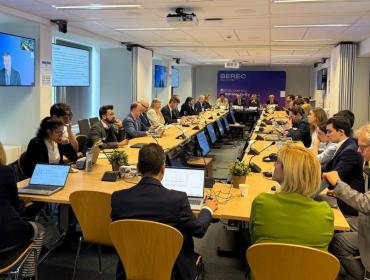
The public consultation on the impact of generative AI and on internet openness forms part of BEREC’s broader work on the dynamics of the digital ecosystem. It aligns with the wider priorities reflected in the draft BEREC Work Programme 2027, which BEREC also presented at the public debriefing on 7 October 2026 and will equally be subject to public consultation throughout October.
Where Europe’s telecoms stand in the global context – Europe’s Telecom Reality Check
Europe’s telecommunications sector performs comparatively well across a broad range of indicators, such as delivering affordable services, improving fibre and 5G connectivity, investment and consumer benefits. Overall, the EU’s competition-oriented, evidence-based regulatory framework supports top-class results. Europe’s Telecom Reality Check, BEREC’s fact-finding report on connectivity, competition and regulatory highlights in different jurisdictions compares the EU’s broadband connectivity, network quality and market performance with those of major global economies, including the USA, South Korea, Australia and Japan. Based on publicly available sources and stakeholder input received during the public consultation, BEREC has examined connectivity, pricing, quality of service, competition, access regulation and financial conditions. The findings highlight several European strengths, including latency as a clear area of comparative advantage, fixed and mobile broadband prices that compare favourably with major international peers, and operator returns that generally exceed the cost of capital. At the same time, performance is not uniform across the EU. The best-performing Member States rank among global leaders, although connectivity and network quality continue to vary across national markets.
Note for editors: A dedicated media kit is available alongside the report, providing ready-to-use materials for journalists and other stakeholders. It includes visuals, infographics and one-pagers highlighting the key findings and results of the fact-finding report, making the evidence and its implications easy to understand and share. A podcast discussing the fact-finding report will be available on BEREC’s communications channels in the upcoming months.
Access to State-aid funded networks
Public investment has helped to bring high-speed fibre networks to areas where market-driven deployment would not be viable. The EU rules require effective wholesale access to subsidised broadband networks on fair and non-discriminatory terms, providing flexibility for Member States in their application. Thus, practical application of these rules varies across countries. In its draft report, published on the website, BEREC examines how national regulatory authorities participate to the evaluation of access products, conditions, and pricing for fixed state-aid-funded networks. This assessment includes economic and technical perspectives and covers both active and passive access services. Drawing on information collected from national regulators, the report identifies common approaches and good practices, aiming to support effective competition, promote the efficient use of public funds and encourage greater harmonisation of approaches across Europe. The public consultation is open until 13 November 2026.
BEREC’s work in 2027
As the European Union prepares a new regulatory framework for connectivity, BEREC will continue to provide expert, independent advice to the co-legislators and the European Commission as well as to support full connectivity, promote competitive and open digital ecosystems, and empower end-users. The draft BEREC Work Programme outlines BEREC's planned contributions in 2027 to significant policy and regulatory developments in particular the proposal for a Digital Networks Act (DNA) published in January 2026. BEREC is committed to provide expert and independent advice along the legislative procedure. The Work Programme also includes BEREC’s advice for European Commission's (EC) review of roaming and intra-EU communications, as well as advancements in EU digital policy. Notably, it covers the review of the Digital Decade Policy Programme and the EC's broader agenda for digital simplification, which includes the Digital Omnibus and the Digital Fitness Check.
The draft Work Programme reflects proposals from BEREC members and stakeholders through a collaborative process that included an early open call for input at the beginning of 2026 and this public consultation. Stakeholders are invited to submit their comments on the draft BEREC Work Programme 2027 by 31 October 2026.
Public documents available online
A full list of the public documents adopted at BEREC’s 68th ordinary meeting (1-2 October 2026, Dubrovnik, Croatia) is available on the BEREC website. The presentation and the video recording of the BEREC public debriefing will be available shortly. The 69th BEREC ordinary meeting will take place on 3-4 December 2026, in Belgium. The next BEREC public debriefing will be held online on 9 December 2026.