04 November 2026
New opportunities and regulatory challenges for MVNOs in Europe
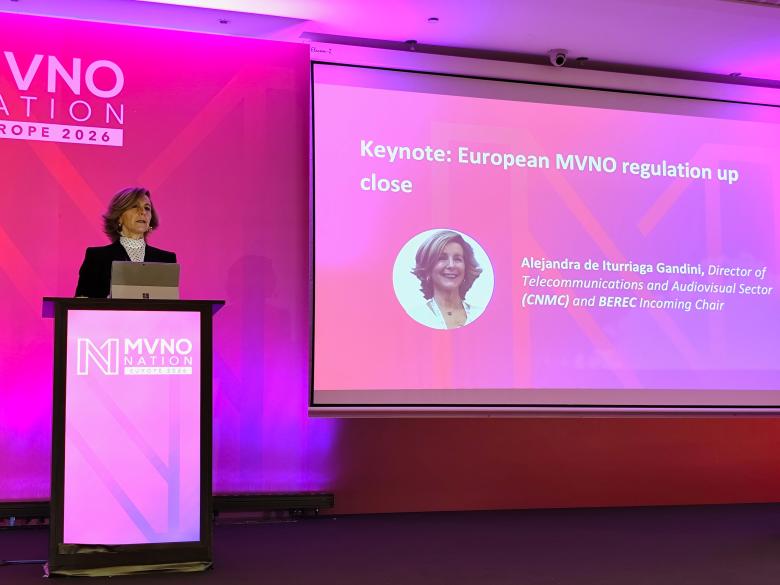
On 4 November 2026, incoming BEREC Chair Alejandra de Iturriaga delivered a keynote speech, “European MVNO Regulation Up Close”, at MVNO Nation Europe in Benidorm, Spain. She addressed upcoming regulatory developments affecting mobile virtual network operators (MVNOs), their role in the telecommunications market and the challenges they face when expanding across Europe.
MVNOs support competition and innovation
Alejandra de Iturriaga highlighted the important contribution MVNOs make to competition and innovation in Europe’s electronic communications market. She noted that, while MVNOs have traditionally been associated with consumer services, some of the most promising growth opportunities are now emerging in services for business customers and in the Internet of Things, where connected devices such as sensors, vehicles and machines rely on mobile connectivity. Referring to a BEREC study on wholesale mobile connectivity, she stressed that effective access to capabilities such as 5G Standalone, network virtualisation and eSIM is essential for MVNOs to differentiate their services and replicate and scale innovative B2B and IoT solutions across European markets.
She also pointed out that barriers to competition may increasingly arise beyond the network layer, including in devices, operating systems and digital onboarding processes. In response, the BEREC Work Programme for 2027 includes a dedicated workshop on barriers to providing electronic communications services. The workshop will provide an opportunity to engage with stakeholders and examine practical difficulties that may affect operators, including MVNOs, when providing services or expanding their offers.
Key regulatory developments ahead
Looking ahead, Alejandra de Iturriaga highlighted two regulatory developments of particular interest to the MVNO community: the future Digital Networks Act (DNA) and the review of the Roaming Regulation. Alejandra de Iturriaga underlined that future regulation should support innovation while reflecting the different market conditions across Member States. From BEREC’s perspective, market-shaping measures should be tailored to national realities rather than follow a one-size-fits-all approach.
She noted that the DNA will be particularly relevant for MVNOs, as changes to spectrum policy may affect market entry, competition and innovation. She also referred to the growing importance of direct-to-device satellite connectivity. For MVNOs, these developments may create new opportunities for specialised services and new wholesale arrangements.
Turning to roaming, Alejandra de Iturriaga underlined that the Roaming Regulation remains one of the most visible achievements of the European Digital Single Market and it is particularly important for many MVNO business models. She added that BEREC will continue to contribute to the implementation, monitoring and review of the Roaming Regulation through data collection and stakeholder engagement.
The incoming BEREC Chair concluded her keynote speech by stressing that the future of connectivity in Europe will depend on investment, innovation and competition working hand in hand. She highlighted the important contribution MVNOs have made to the development of the telecommunications market and expressed confidence that they will continue to play a significant role in the years ahead.