24 June 2026
Competition - a key driver of investment and consumer welfare
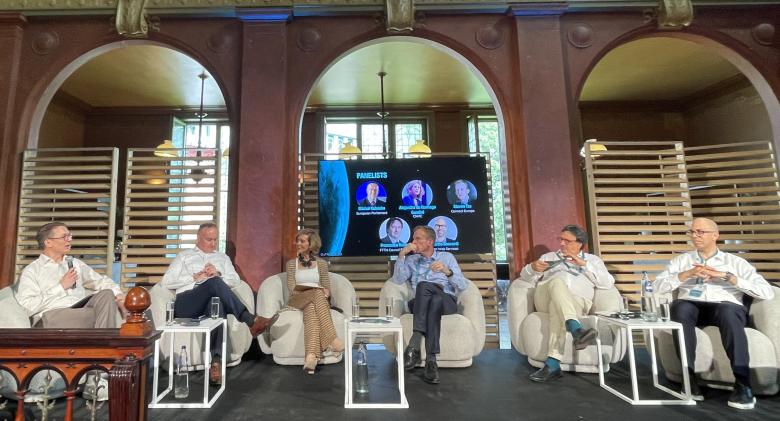
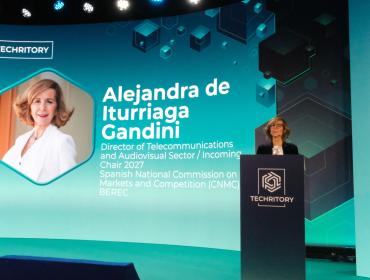
The incoming BEREC Chair, Alejandra de Iturriaga, presented BEREC’s perspective on the Digital Networks Act (DNA) proposal during the panel Is DNA Fit for the Age of Fibre, 5G/6G and Satellite? at Cullen International’s 40th Anniversary Conference.
Together with policymakers and industry representatives, she discussed how Europe’s future telecoms framework can support investment in next-generation networks while ensuring effective competition and efficient regulation.
According to Ms. De Iturriaga, many of BEREC’s messages converge on one central idea: competition remains a key driver of investment and consumer welfare. The incoming BEREC Chair also highlighted the importance of striking the right balance in allocating tasks among the European Commission, national regulatory authorities and Member States.
Ms. De Iturriaga outlined BEREC’s continued involvement in the process and its assessment of the DNA proposal, stressing that the future framework should evolve existing rules rather than completely redress them, preserving approaches that have proven effective.
Flexible approach to copper switch-off
A key topic of the discussion was the proposed copper switch-off framework. Ms.De Iturriaga noted that Member States are at very different stages of fibre deployment and therefore require flexibility in the future rules. She emphasised that the framework should avoid unnecessary complexity and reflect national circumstances.
Satellite authorisation
Regarding the proposed EU-level satellite authorisation framework, Ms. De Iturriaga stressed that BEREC’s concern is not harmonisation itself, but excessive centralisation at the EU level. She noted that spectrum management has implications beyond telecommunications, including defence, scientific research and broader geopolitical considerations. Member States continue to play a role in addressing issues such as interference coordination, security requirements and national specificities.
Evolution, not revolution
De Iturriaga concluded that the Commission’s approach to the DNA is constructive as it builds on an existing framework that has already delivered results. In her view, there is no single magic solution to transform the sector. The DNA should be seen as an evolution of current rules, focusing on targeted improvements and simplification rather than a fundamental redesign. It builds on what has worked well at both the EU and national levels while addressing how the framework can adapt to technological change and the evolving single market.