19 February 2026
Driving Europe’s connectivity and competitiveness

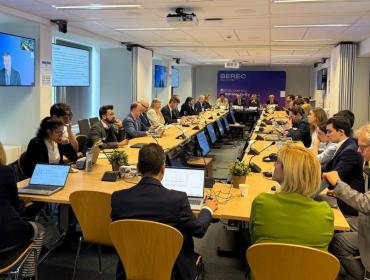
At the Future Connectivity Summit Europe on 18 February 2026, the BEREC Chair Marko Mišmaš (AKOS, Slovenia) said that connectivity now plays a decisive role in strengthening European sovereignty and can no longer be seen as a purely sectoral concern. Instead, connectivity has become a strategic pillar for underpinning Europe’s resilience, competitiveness and security in an increasingly complex global landscape.
In the lead-up to the adoption of the new Digital Networks Act (DNA), BEREC Chair stressed that the new regulatory framework must modernise, and not destabilise. He described the forthcoming Regulation as a major opportunity for enhancing Europe’s competitiveness, resilience, and sustainability. At the same time, he warned that competitiveness must not come at the expense of competition.
The BEREC Chair clarified that in 2026 the European regulators will focus on regulatory simplification, harmonisation, and legal certainty, to ensure that modernisation strengthens the market without creating instability.
In his keynote speech, Marko Mišmaš identified the importance of secure connectivity, the development of 6G, maintaining an open internet, fostering investments, and supporting a vibrant digital ecosystem. He recognised that these issues are all interconnected and must be addressed together as part of a single strategic conversation about Europe’s digital future.
BEREC stands ready to contribute independently, pragmatically, and constructively ensuring that Europe’s connected future is secure, resilient, and future-ready.
Digital investment and regulation
Achieving full gigabit connectivity by 2030 requires an acceleration of investment, the BEREC Chair Marko Mišmaš said during the panel discussion on the interplay between Artificial Intelligence (AI) and connectivity. The discussion focused on how an advanced digital infrastructure supports AI innovation and the challenges that Europe faces in building a resilient, future-proof digital ecosystem. The BEREC Chair suggested expanding the so-called ‘regulatory sandboxes’ to enable the rapid testing and scaling of new technologies. This approach would help ensure that an advanced infrastructure and innovation tools are available across Europe, and not just in major tech centres. Marko Mišmaš added that AI regulation must provide a clear, balanced framework that aligns standards, legal clarity, and proportional obligations. Regulation should reflect the technical realities and avoid sanctions before standards are established. At the same time, it should offer proportionate support to growing European scale-ups to foster innovation, investment, and AI development across Europe.
Secure and resilient networks
The Summit participants also discussed security and resilience that have become a central policy priority. In the panel discussion on network security and resilience, Katja Kmet-Vrčko (the BEREC Contact Network Chair and Cybersecurity and Resilience Working Group Co-Chair) highlighted BEREC’s active role in strengthening EU cybersecurity capabilities and network resilience. She stressed that collaboration with the NIS Cooperation Group, ENISA, and the European Commission is essential, and no longer just optional.
Building on the discussion on secure and resilient networks, Katja Kmet-Vrčko underlined that the proposed DNA sends a strong and timely signal by treating resilience as a core priority. In her remarks, she welcomed the fact that the current proposal addresses network resilience in a serious and structured manner — a recognition of the realities Europe faces today. Against the backdrop of Russia’s invasion of Ukraine and an increasingly fragile geopolitical environment and climate changes, resilient and reliable communications networks are essential. However, legislation alone will not be sufficient to guarantee resilience. Effective implementation will depend on close coordination among multiple stakeholders, including national governments, regulators, operators and other public authorities.
Beyond the legislative debate, BEREC is actively contributing its efforts to mitigate supply chain risks in order to strengthen the resilience of electronic communications networks. It is also examining the role of national regulatory authorities by mapping competences, promoting the exchange of best practices, facilitating stakeholder dialogue and providing expert input to forthcoming European initiatives.